
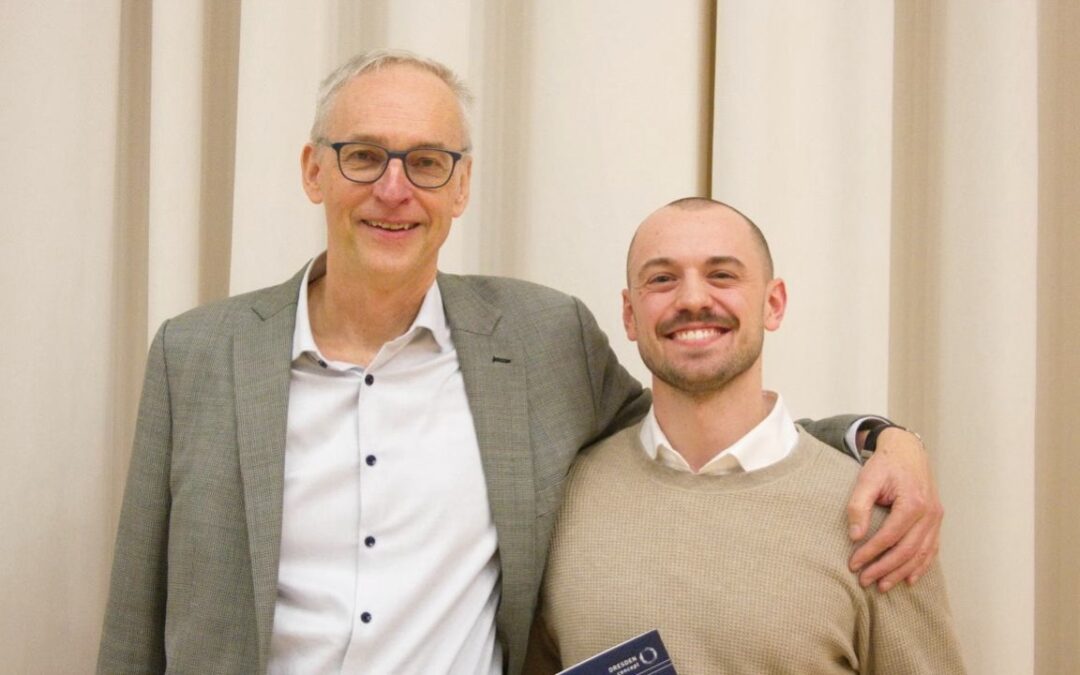
Two outstanding young researchers have been celebrated with the Schwabe Thesis Award at TU Dresden. Since 1996, the Professor Schwabe Foundation presents the Professor Schwabe Prize to master’s and doctoral theses in physical chemistry or in applied sensor research that integrates advanced biochemical or electrochemical elements.
The prize recognizes
- scientific excellence,
- impact,
- clarity of presentation,
- academic achievement,
- and future potential.
PhD Thesis Award
This year’s award for the best doctoral thesis was handed to a researcher whose work has made a remarkable scientific contribution: Dr. Lukas Bongartz.
Dr. Bongartz’s thesis titled “Bistable Organic Electrochemical Transistors: Thermodynamics and Symmetry Breaks” addresses a class of devices that differ fundamentally from conventional transistors: organic electrochemical transistors, or OECTs. These devices operate by coupling electronic and ionic charge transport – a mechanism that renders them uniquely promising for applications such as bioelectronics, neuromorphic systems, and advanced sensing.
As his supervisor, Prof. Karl Leo, emphasizes in his nomination letter, OECTs display a richness of physical phenomena that cannot be captured by classical transistor models. Understanding their behavior therefore requires not only technical expertise, but also scientific creativity, and Dr. Bongartz has demonstrated both at the highest level.
Master Thesis Award
The Professor Schwabe Prize 2025 for the best master’s thesis was handed to M.Sc. Jannis Kockläuner, whose work stands out for its originality, depth, and exceptional independence.
Mr. Kockläuner completed his Master’s thesis at the Chair of Theoretical Chemistry under the supervision of Prof. Thomas Heine and Dr. Jan-Ole Joswig, who also nominated him for this award.
The thesis, titled “Exploring neural network quantum states for non-covalent interactions in quantum chemistry”, was graded 1.0 – sehr gut and represents an impressive achievement at the frontier of quantum chemistry and machine learning.
We would like to warmly congratulate the winners again for their wonderful work, and thank everyone who participated!